Mastering Peak Oversteer Performance Via Metrics and Surgical Setup
Inside the intensely competitive realm of today's professional drifting, victory is no longer exclusively a function of brute horsepower or driver aggression. Conversely, it has become a complex engineering challenge which demands a scrupulous blend of selecting a proven car, equipping it with the most precise performance components, and, most essentially, understanding its real-time behavior on the circuit through advanced vehicle dynamics analysis tools. This definitive manual will serve as your master plan starting from the very first idea of a drift build through to the final data-informed refinements that transform a powerful vehicle into a repeatable winner. We will thoroughly explore the methodical process of car suspension tuning, demonstrating how a modern suspension tuning tool like GripDial eradicates approximation and delivers unparalleled insight into your chassis's real-world performance.
The foundation of any exceptional drift machine is, without question, the chassis itself. Several vehicles have earned legendary reputation within the international sliding culture due to their inherent handling characteristics, durable design, and the enormous availability of performance parts available. Selecting the right platform is the initial and most significant choice a driver will make. As an example, the BMW E36 is commonly accepted as one of the finest balanced cars for drifting of history. Its excellent balanced front-to-rear weight, alongside a rear-wheel-drive layout and bulletproof straight-six engines, establishes a platform that is at once accessible for novices and incredibly effective in the possession of a expert pilot. The successor of this concept, the E46 model BMW, improves on these attributes with a more refined chassis, wider track for enhanced high-speed stability, and still increased steering angle as standard from the OEM. A distinct formidable contender in the top-level arena is the Corvette C6.
This American track weapon offers a distinctive set of strengths to the drifting world, featuring a lightweight aluminum frame, a rear-mounted drivetrain component that helps create an perfect balance, and the immense torque of a large-displacement LS V8 motor. This fusion transforms it into an complete force on track, designed of entering and holding extended angles with relatively minimal use of acceleration. For drivers desiring outstanding bang-for-the-buck, the Nissan 350Z excels as a top-tier choice. It arrives from the manufacturer with a rigid body structure, a effective factory locking differential, and the responsive VQ35DE powerplant that provides sufficient power and torque for learning and progressing in the discipline. Its newer version, the Nissan 370Z, brings additional advancements in structural rigidity, suspension design, and outright motor power, cementing its position as a favorite choice among competitive drivers. Additional historic vehicles that merit consideration encompass the agile Wankel-engined Mazda FC RX-7, the most popular Nissan S13 240SX, the American Ford SN95, the more recent BMW E90, and the compact yet surprisingly playful and teachable MX-5 Miata. All of these chassis gives a unique array of characteristics, challenges, and potentials, but they all possess the core ingredients necessary to be transformed into a serious drift car.
However, selecting the right platform is only the first step. To access the complete capability of any of these cars, major modifications to the steering system and chassis control systems are absolutely non-negotiable. This is where the world of specialist tuning components becomes critical focus. The one most transformative upgrade for a purpose-built competition vehicle is the fitting of a drift-spec steering angle kit. These engineered kits, like those manufactured by industry leaders like SLR Speed, are designed to radically expand the car's available lock-to-lock rotation. A factory road car is extremely limited in how far its tires can pivot, a engineering compromise for daily use. In oversteer driving, conversely, aggressive countersteering is constantly necessary to catch and hold a slide. An modification kit exchanges the factory steering knuckles, rod ends, and sometimes control arms with parts that permit the wheels to attain angles in excess of 70 or even 80 degs, versus a typical OEM limit of around 40 to 50 degrees.
This vastly expanded capability gives the operator with significantly greater authority during a slide, enabling it to be much easier to initiate a slide, hold it through a sweeping bend, and switch smoothly from one side to the opposite. The improvement in drivability is nothing short of revolutionary. Combined with a properly selected steering kit is the just as vital enhancement to the vehicle's suspension. Generic or including premium road dampers are simply not designed for the specific and harsh requirements of sliding. A purpose-built system of adjustable dampers is paramount. These specific dampers feature custom valving and spring rates that are tuned for the rapid weight transfer that is inherent of sliding. When a driver initiates a slide, the vehicle's inertia is shifted forcefully to the outside of the bend. Proper drift-spec suspension handle this movement in a consistent manner, allowing the vehicle to stabilize quickly and providing the operator precise feel through the steering wheel and seat. They also enable accurate tuning of ground clearance, rebound and compression stiffness, and cross-weight, which are all integral elements of dialing in the vehicle's handling to a particular track or piloting style. Together, a high-quality drift angle kit and a expertly specified system of competition suspension units form the absolute hardware base upon which all later refinement is built.
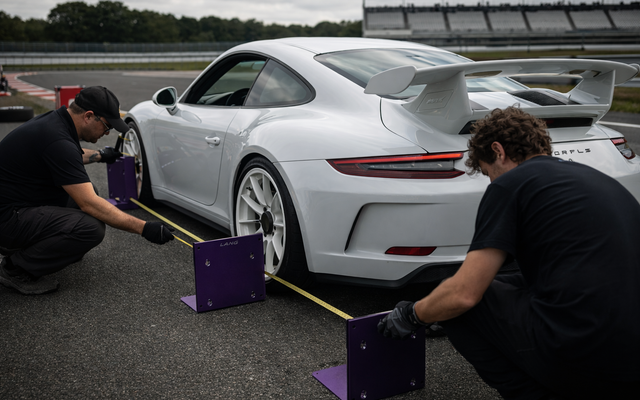
Once the fundamental parts is fitted, the following vital phase in the project is the precise adjustment of the car's wheel angles. This is the domain of vehicle alignment optimization, a procedure that can appear daunting to the beginner but is, in practice, the key to transforming a set of high-performance pieces into a harmonious and controllable vehicle. The most debated parameter of tuning for oversteer is certainly camber. Camber angle is the inclination of the rim relative to the upright line when looked at from the forward of the chassis. If the upper part of the wheel is leaning inward, this is referred to as inward tilt. In drifting, an inward tilt on the steering tires is widely applied and is regarded as critical. The purpose is deeply related to physics.
When a car is turning at high slip angles, the frame rolls toward the outer of the corner. This chassis roll forces the outside front tire to lose its optimal grip area with the asphalt. By introducing inward lean, the wheel is pre-tilted to counteract this tilt. As the chassis leans into the turn, the tire gains a better contact patch with the asphalt, optimizing its traction at the exact moment when it is needed most for control. Commonly, front axle angles for a serious drift car range from approximately -3 degrees to as much as -5 degrees or even beyond, contingent on the details of the chassis setup, compound type, and pilot preference. The rear tires also employ inward lean, but the angles are generally more conservative and less aggressive than the front axle. Overly aggressive negative camber at the rear can cause the vehicle to overly tail-happy and challenging to control on power application, as it reduces the effective tire footprint of the driving tires during forward throttle application. Hence, rear axle angles are frequently in the range of -1 degree to -3 degrees, achieving a precise compromise between providing adequate side grip to aid in entering and maintaining the drift while simultaneously maintaining effective hook-up for exiting the turn. Camber is merely one component of suspension tuning tool the larger alignment puzzle, which also involves toe angle, caster, and steer correction correction.
Toe angle describes the orientation of the wheels as seen from above. Toe-in means the front edges of the tires are closer together than the rear edges, while negative toe means the opposite. For sliding, a modest amount of front negative toe is commonly used to sharpen the turn-in directional reaction, making the car feel more nimble and ready to initiate a drift. Rear axle toe is usually set to zero or a extremely minute amount of positive toe to promote predictability under throttle. Caster is the longitudinal or rearward inclination of the steering axis when looked at from the lateral of the chassis. More caster angle increases feedback and high-velocity solidity, and it furthermore boosts camber effect during steering, which is extremely useful. Adjusting these parameters is a complex interaction where a adjustment to one setting can and often will influence the remaining parameters. The conventional approach for setting a chassis's suspension geometry for sliding has for a long time been a labor-intensive process of experimentation and feeling. A driver or team would make a change based on a hunch, drive the car on track, rely on the driver's subjective feel and impressions, and then introduce a further change. This cycle would iterate time after time until the chassis felt "acceptable" or the scheduled practice time ran out. This methodology is not only incredibly inefficient in terms of man-hours and costs, but it is also deeply inaccurate.
Human feel is a infamously unreliable measurement tool, colored by numerous factors such as fatigue, evolving track surfaces, temperature, and merely the drift telemetry software mood of the operator on that specific day. What feels "tail-happy" on one pass might feel "understeery" on the next run, causing contradictory feedback and counterproductive changes. This traditional problem in car suspension tuning is exactly where state-of-the-art engineering tools has stepped in to transform the process.
The rise and application of advanced suspension tuning applications has ushered in a completely new age for engineering and refining professional drift cars. These tools, represented by groundbreaking solutions like data acquisition tools, function by directly measuring the real-time dynamic movement of the chassis as it is being driven on the circuit. As opposed to using driver feel, these devices gather objective information on essential factors such as suspension travel, individual tire rotation, acceleration forces, steering angle, and throttle and brake application. This raw telemetry is then processed by sophisticated applications that can plot and interpret the metrics in a comprehensible way. For the first time, tuners and builders can observe precisely what the car is exhibiting at every millisecond of a lap. This ability transforms the complete suspension tuning workflow. Think about the specific challenge of setting the front camber for a given chassis. Instead of introducing drift angle kits a adjustment from -3 degrees to -3.5 degrees and then driving many runs to try and "feel" a change, a suspension tuning tool can give instant and irrefutable data. The tool can show visually how the tire's grip is behaving during the most important phases of a slide: the initial flick, sustain, and changing direction. It can reveal if the current angle is permitting the steering tire to maintain maximum grip or if the compound is working inefficiently on its external edge.
The software can after analysis suggest fact-based advice for modification. Perhaps the data reveals that the outside front tire is still stressing its sidewall at -3.5 degrees of negative camber, indicating that a move towards angle, say -4 degrees, might be warranted. On the other hand, the data might indicate that the tread is failing to coming up to heat or that the inside shoulder is degrading excessively, which could point to that there is overly aggressive inward lean and a modest decrease back to -3.2 degrees would be better optimal. This level of precision and practical intelligence was literally unattainable in the era of exclusively manual adjustment.
The benefit of using a dedicated drift telemetry system goes well beyond only optimizing alignment. It serves as an invaluable damper adjustment manual that is customized to your specific car. When fine-tuning the rebound and compression values on your adjustable dampers, rather than depending on general guidelines or mimicking another driver's setup, you can utilize the telemetry to see how the car is performing in relation to your tweaks. The software can show the wheel movement trace over a lap, showing if the shocks are managing the chassis motion effectively or if they are permitting the chassis to bounce too much after a flick. It can help in diagnosing issues like bottoming out or topping out, permitting you to introduce educated choices to preload settings, damping rates, or stance. This process applies equally to the intricate task of car alignment tuning. In addition to camber angle, the software can offer analysis into how adjustments to toe and caster angle are impacting the vehicle's balance during different parts of a slide. For example, it can assist you to find the optimal amount of front negative toe for your particular angle kit setup and piloting style by measuring the quickness of turn-in response and the stability of the car at maximum countersteer. This turns the tool an incredibly effective drift suspension tuning guide that is actively updated by the real-world behavior of your personal car on the track. It elevates the complete process from a mysterious craft into a methodical engineering exercise.
Furthermore, the application of a platform like data acquisition is not limited to professional engineers with extensive resources. For the amateur enthusiast, it serves as an incredible educational tool. It effectively offers the driver with the insight of a professional race engineer without needing the associated cost. It drastically shortens the tuning process by providing definitive answers to questions that would traditionally take countless track days of experience to understand. A builder can learn how their individual chassis reacts to different adjustments, gaining a deeper knowledge of vehicle dynamics in the endeavor. It also democratizes advanced suspension engineering principles, enabling all drivers with the ambition to refine their car to achieve it in a systematic and effective manner. This is particularly significant in a sport like sliding, where tuning know-how has traditionally been a highly secretive advantage among elite drivers. Now, that knowledge can be in the hands of every motivated driver.
In summary, the path to building and optimizing the perfect championship-contending drift machine is a multi-faceted endeavor that smoothly blends classic engineering wisdom with revolutionary digital tools. It commences with the wise pick of a capable car, followed by the integration of critical competition components like high-performance steering angle kits and expertly valved competition suspension units. The process then progresses into the precision realm of alignment optimization, where values like camber, toe setting, and caster angle are carefully set to match the vehicle's modified capabilities and the pilot's individual technique. Ultimately, and what truly separates the modern approach from the past, is the integration of a sophisticated drift telemetry software. This tool eradicates the approximation and trial and error of solely subjective tuning by giving quantifiable, real-time information on how the car is actually functioning. It functions as an unparalleled suspension tuning tool, a actionable alignment optimization handbook, and a master chassis development system. In unison, this complete methodology guarantees that every element of the competition vehicle—from the selection of the chassis to the final adjustment on the suspension—is optimized for peak success on the track. It represents the complete progression of the art of oversteer driving, bridging physical pilot talent with data-informed chassis dynamics to build the ultimate competitive vehicles attainable.